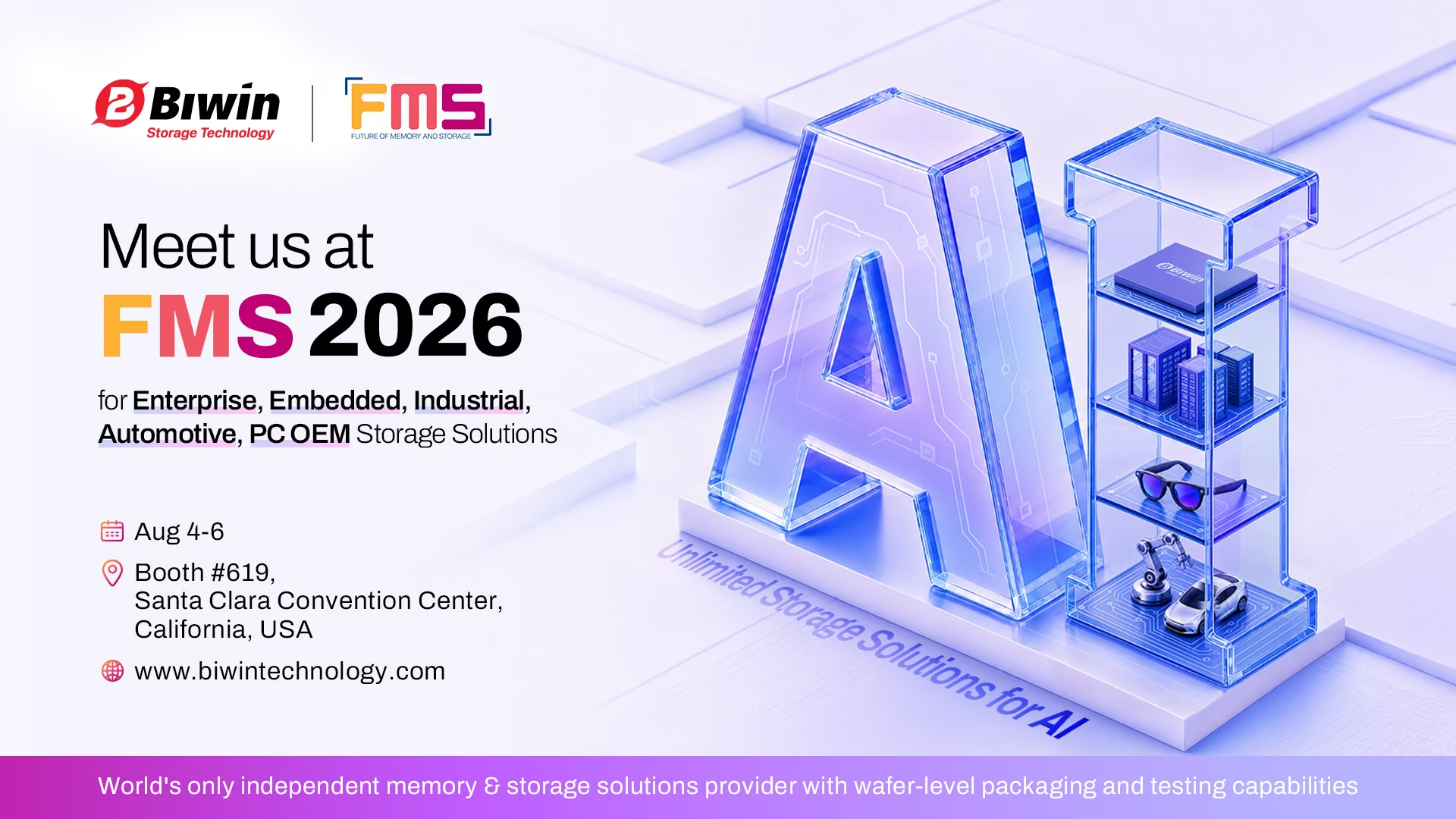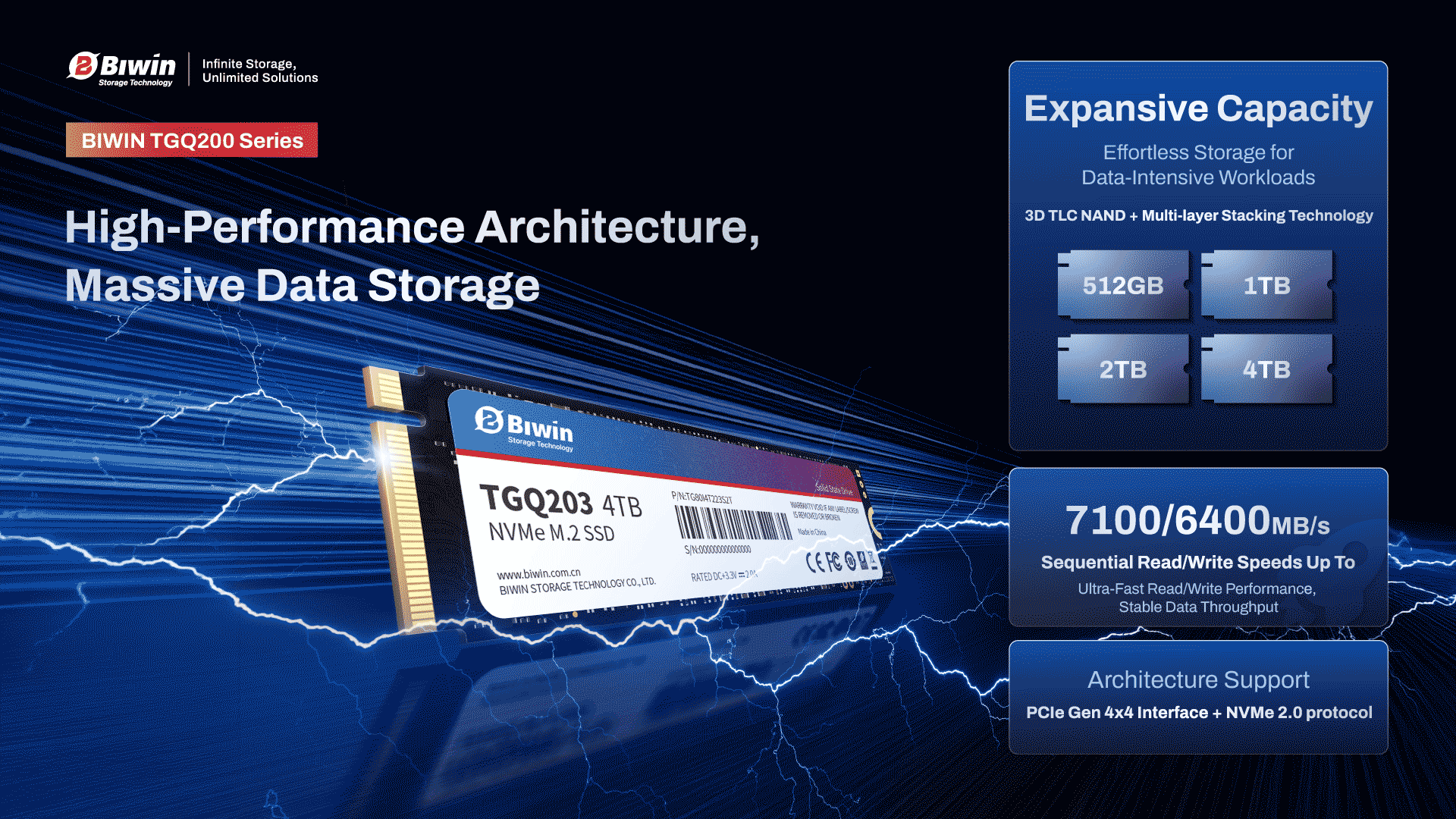
BIWIN, a leading provider of memory and storage solutions, is pleased to announce its participation in embedded world North America 2026, taking place September 22-24 at the Anaheim Convention Center in California. At Booth #6104, BIWIN will showcase its latest solutions across enterprise, embedded, industrial, automotive, and PC OEM storage, highlighting how its technology portfolio supports the growing performance, reliability, efficiency, and integration demands of AI, edge computing, intelligent vehicles, and next-generation embedded systems.
As AI and data-intensive computing extend from the data center to the edge, embedded platforms are being asked to process and manage more data within increasingly demanding system constraints. Storage must deliver not only higher performance and capacity, but also greater power efficiency, robust data protection, compact integration, environmental resilience, and long-term reliability. At embedded world North America 2026, BIWIN will demonstrate how its capabilities across hardware, firmware, storage algorithms, packaging, testing, and manufacturing enable storage solutions engineered for these evolving system-level requirements.

Enterprise Storage: Scaling AI Infrastructure with Greater Performance and Efficiency
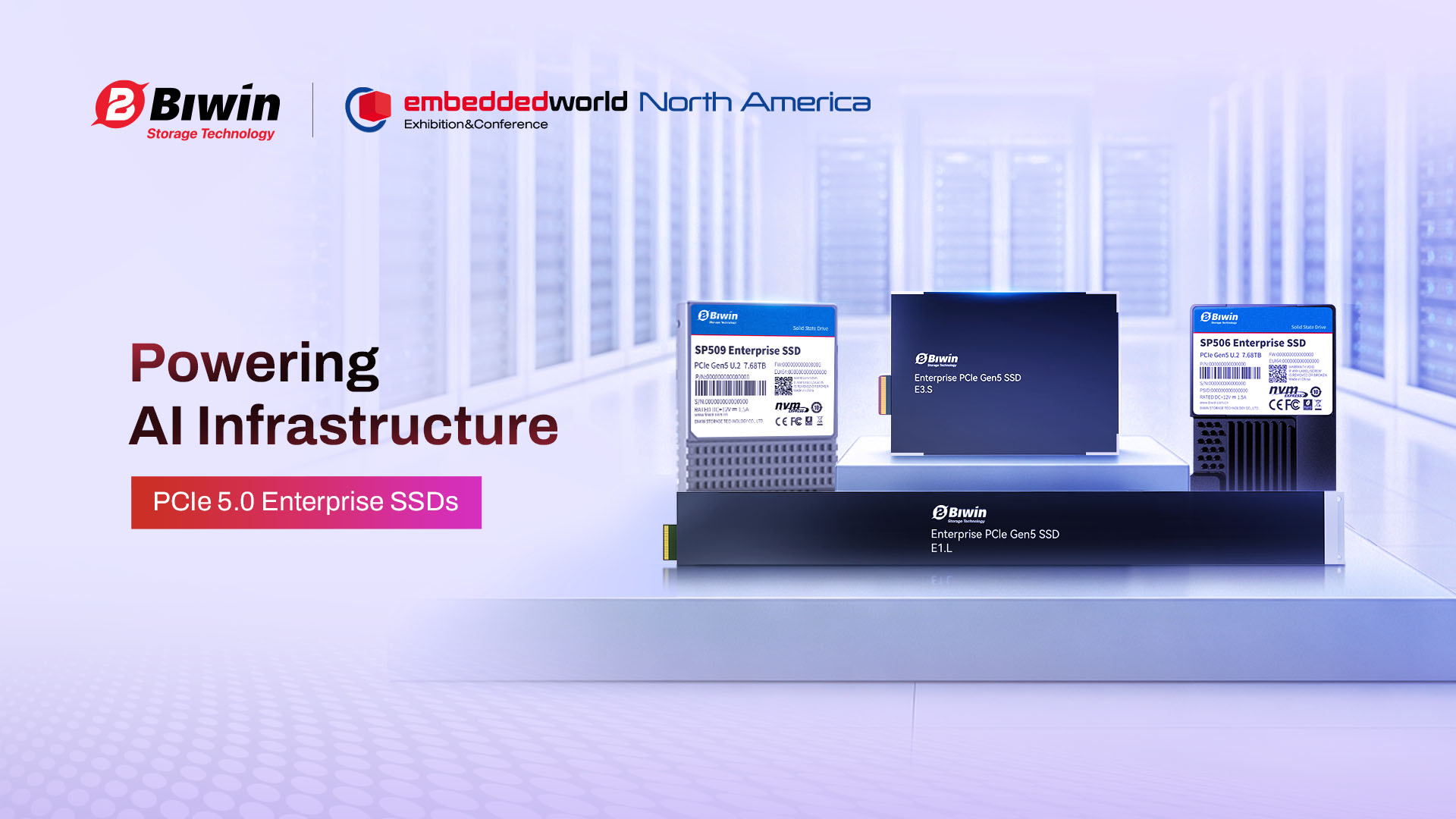
As AI, cloud computing, and other data-intensive workloads continue to place greater demands on data center infrastructure, enterprises need storage that can scale performance and capacity while improving efficiency and controlling total cost of ownership. BIWIN’s PCIe 5.0 enterprise SSD portfolio addresses these priorities across a range of deployment and workload requirements.
SP509/SP519 Enterprise SSDs — Optimized for AI Inference and Training
The SP509/SP519 series is engineered for demanding AI workloads. Its integrated hardware compression engine provides transparent 2:1 compression with zero CPU overhead, enabling sequential read/write speeds of up to 14,700/13,000 MB/s and 4K random performance of up to 3,200K/1,000K IOPS. This helps accelerate data-intensive operations such as KV-cache access and model loading while reducing pressure on host compute resources.
The series also delivers consistently low latency, with read/write latency as low as 55/7 µs and 99.99% QoS maintained within 15/100 µs, helping minimize long-tail latency in latency-sensitive workloads.
Available in 1 DWPD configurations for inference and 3 DWPD configurations for training, capacities range from 3.2 TB to 15.36 TB. By reducing NAND write amplification through hardware compression, the drives can extend service life by up to 5× while significantly lowering overall TCO.
SP5002 E3.S/E1.L Enterprise SSDs — High-Density Storage for Data Lakes and HDD Replacement
The SP5002 series is designed for high-density storage environments, including data lakes, cloud infrastructure, and HDD replacement. With capacities of up to 61.44 TB per drive, it delivers approximately 33% greater storage density than conventional enterprise TLC SSDs.
Available in EDSFF E3.S and E1.L form factors, the SP5002 is well suited to next-generation server platforms and high-density architectures. Despite its large capacity, it maintains PCIe 5.0 performance with sequential read speeds of up to 14,700 MB/s and random read performance of up to 2,300K IOPS. By consolidating workloads that would otherwise require a larger number of HDDs, the SP5002 can help reduce rack footprint, power consumption, and infrastructure complexity while lowering total cost of ownership.
SP506/SP516 Enterprise SSDs — Built for OCP-Compliant Hyperscale Deployments
The SP506/SP516 series is designed for large-scale cloud and hyperscale deployments that require high efficiency, interoperability, security, and reliability. Fully compliant with OCP 2.0 and supporting NVMe-MI 1.2 and TCG Opal 2.0, the series is well positioned for qualification across cloud service provider platforms.
With power consumption of only 22 W while delivering up to 3,200K random read IOPS, the SP506/SP516 offers exceptional performance-per-watt efficiency for hyperscale environments. PCI-SIG and UNH-IOL certifications further support broad interoperability across enterprise platforms.
Embedded Memory & Storage: Integrating More Capability into Smaller Devices
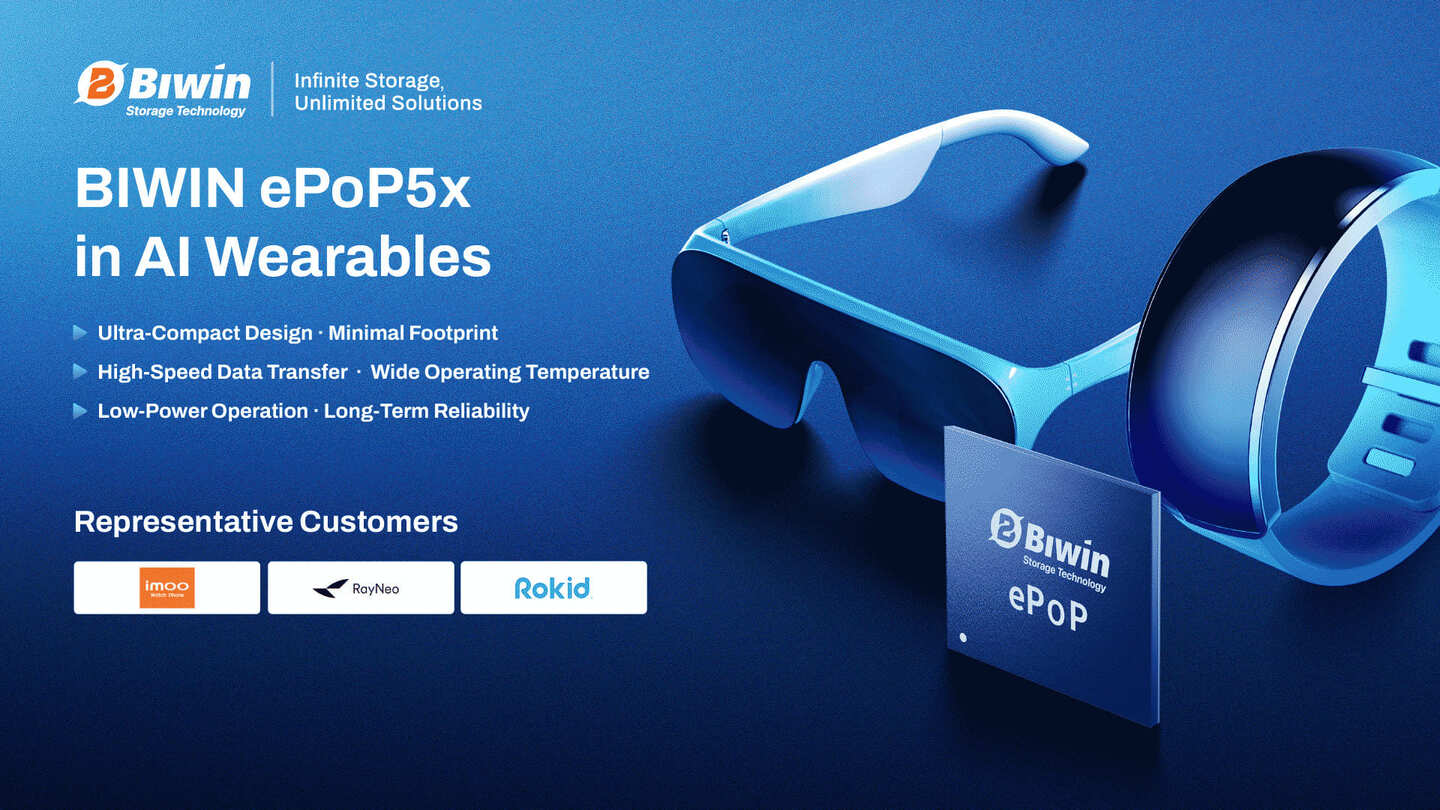
The expansion of AI into wearables, smart vision systems, and other compact devices is increasing memory and storage requirements while placing tighter constraints on board space and power consumption.
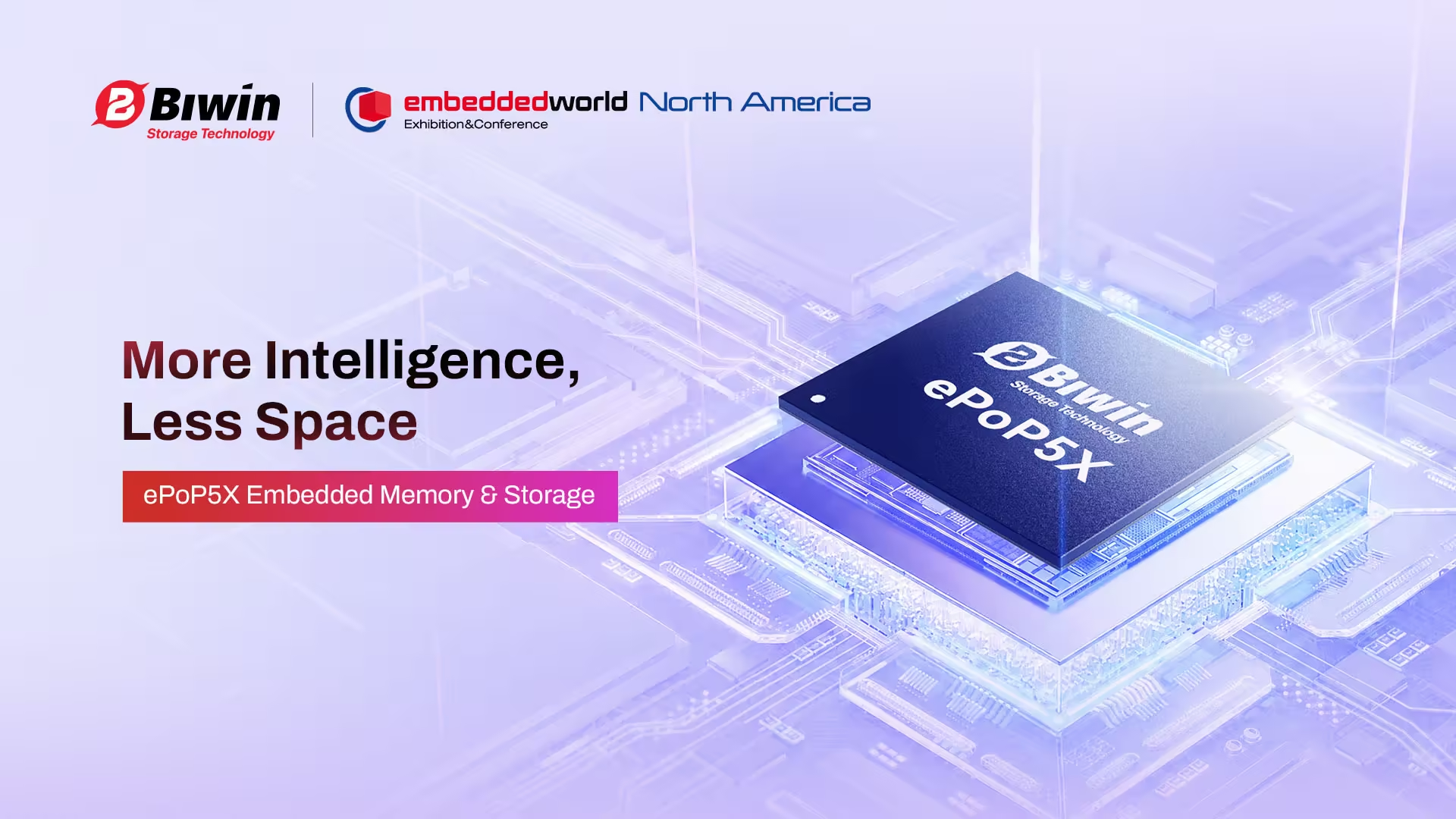
The BIWIN ePoP5X addresses these competing demands by integrating LPDDR5X memory and eMMC 5.1 storage into an ultra-compact Package-on-Package solution. With LPDDR5X speeds up to 8,533 MT/s and a significantly smaller footprint than the previous generation, ePoP5X enables greater memory performance and storage integration within limited PCB space. This combination gives device designers greater flexibility to develop slimmer, more capable platforms for premium smartwatches, AI glasses, and other space-constrained mobile and embedded applications.
Industrial Storage: Sustained Performance and Reliability for Always-On Edge Systems
Industrial edge platforms increasingly combine continuous data acquisition with real-time processing and analytics, placing sustained workloads, environmental resilience, and long deployment lifecycles at the center of storage design.
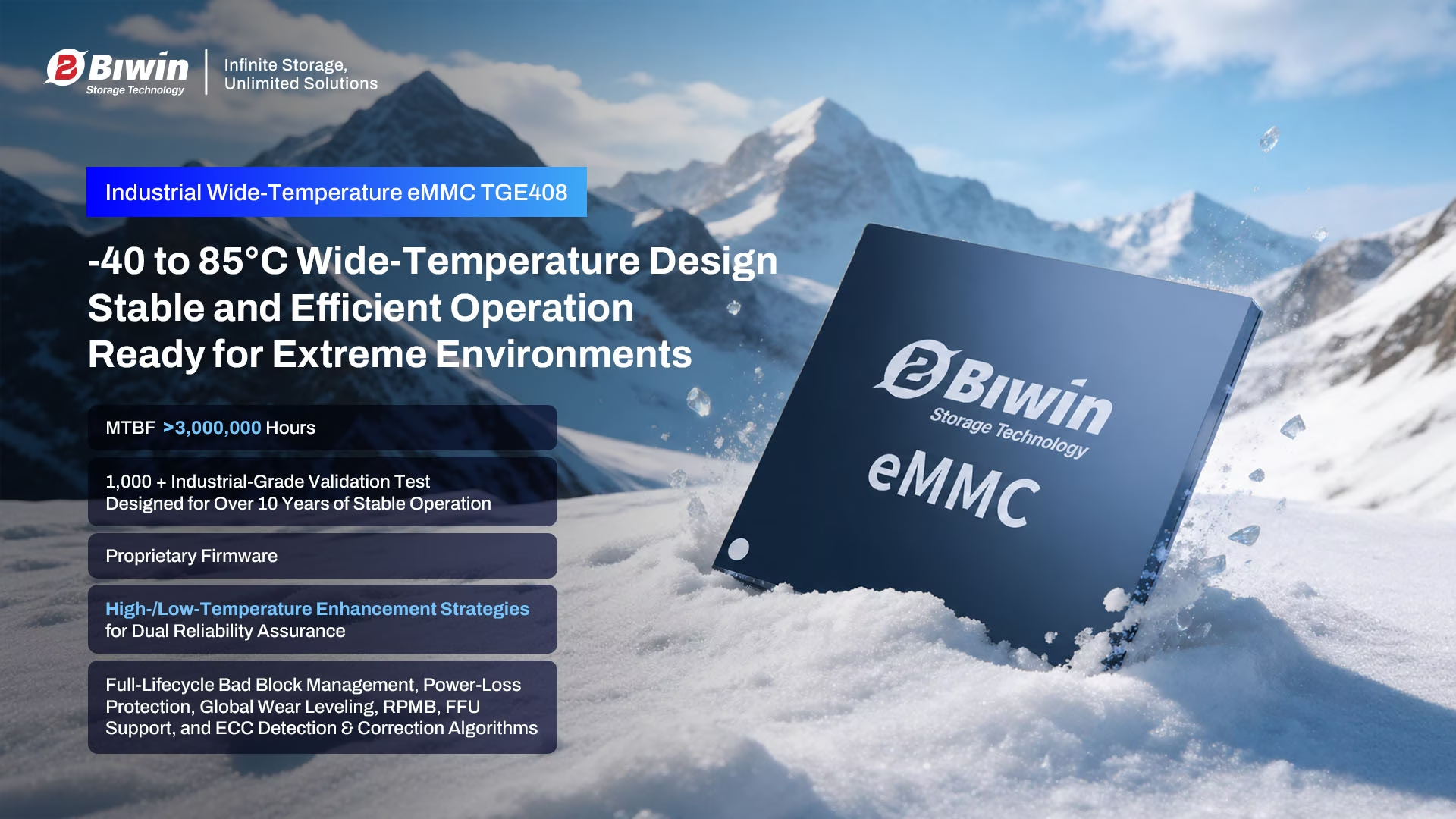
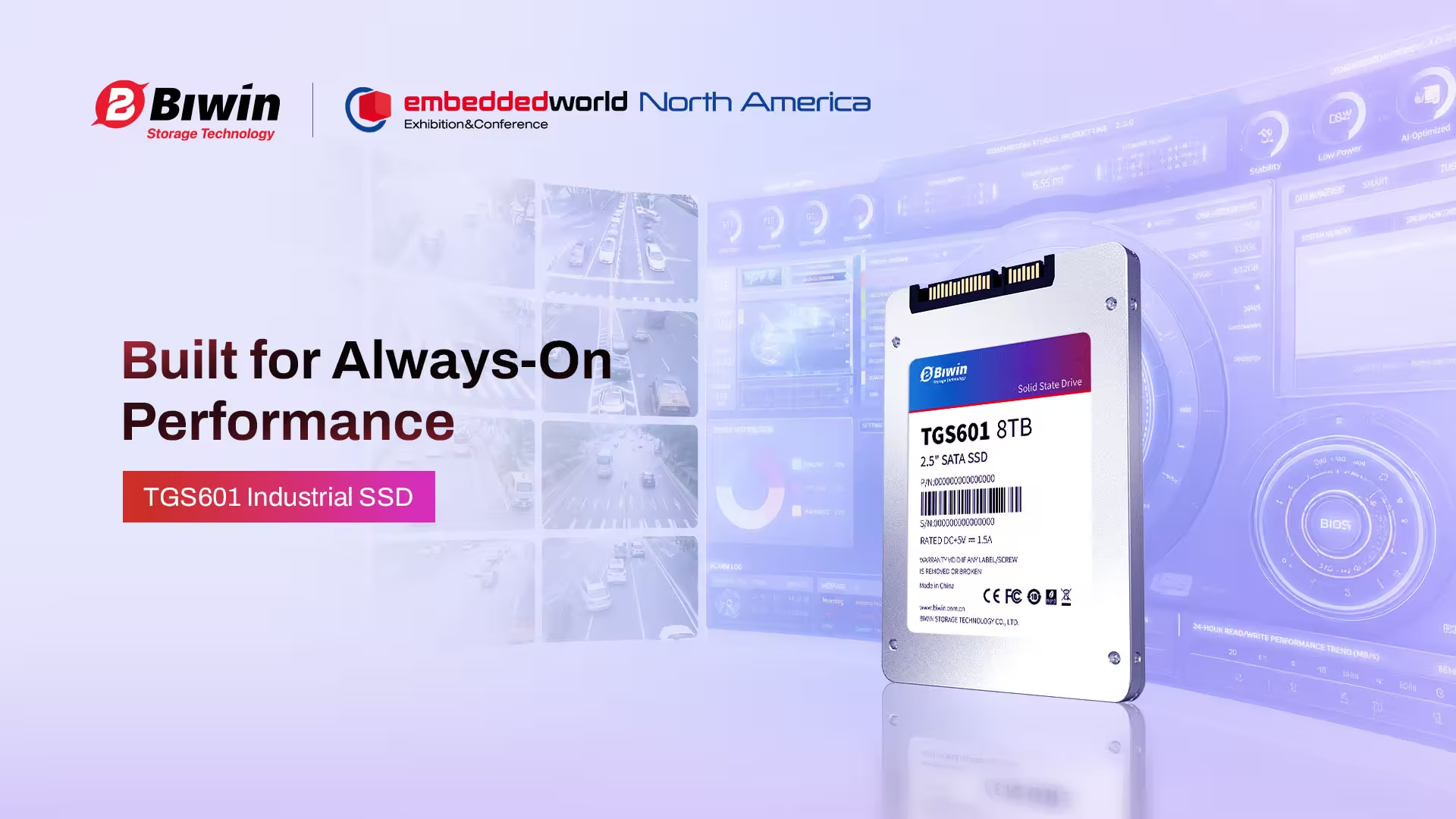
Engineered for these requirements, the BIWIN TGS601 Industrial SSD combines native 4 TB and 8 TB capacities with full-capacity onboard DRAM and reliable operation across a wide temperature range of -40°C to 85°C. For data-intensive surveillance applications, BIWIN’s proprietary Win-REC intelligent write algorithm enables continuous recording of up to 24 simultaneous video streams on a single drive while maintaining consistent write performance to help minimize frame drops and recording interruptions. A multi-layer data protection architecture, including LDPC, internal RAID, memory ECC, and hardware-based power-loss protection, helps safeguard data under demanding operating conditions. Together with BIWIN’s control over firmware development, component selection, packaging, and testing, the TGS601 is designed to provide the sustained performance, product consistency, and long-term supply continuity required for rail transportation, in-vehicle surveillance, edge computing, industrial servers, and other mission-critical deployments.
Automotive Storage: Reliable Data Infrastructure for Intelligent Vehicles
As vehicles evolve toward more centralized and software-defined architectures, storage must support growing volumes of navigation, infotainment, cockpit, sensor, and system data while maintaining predictable operation across demanding automotive environments.
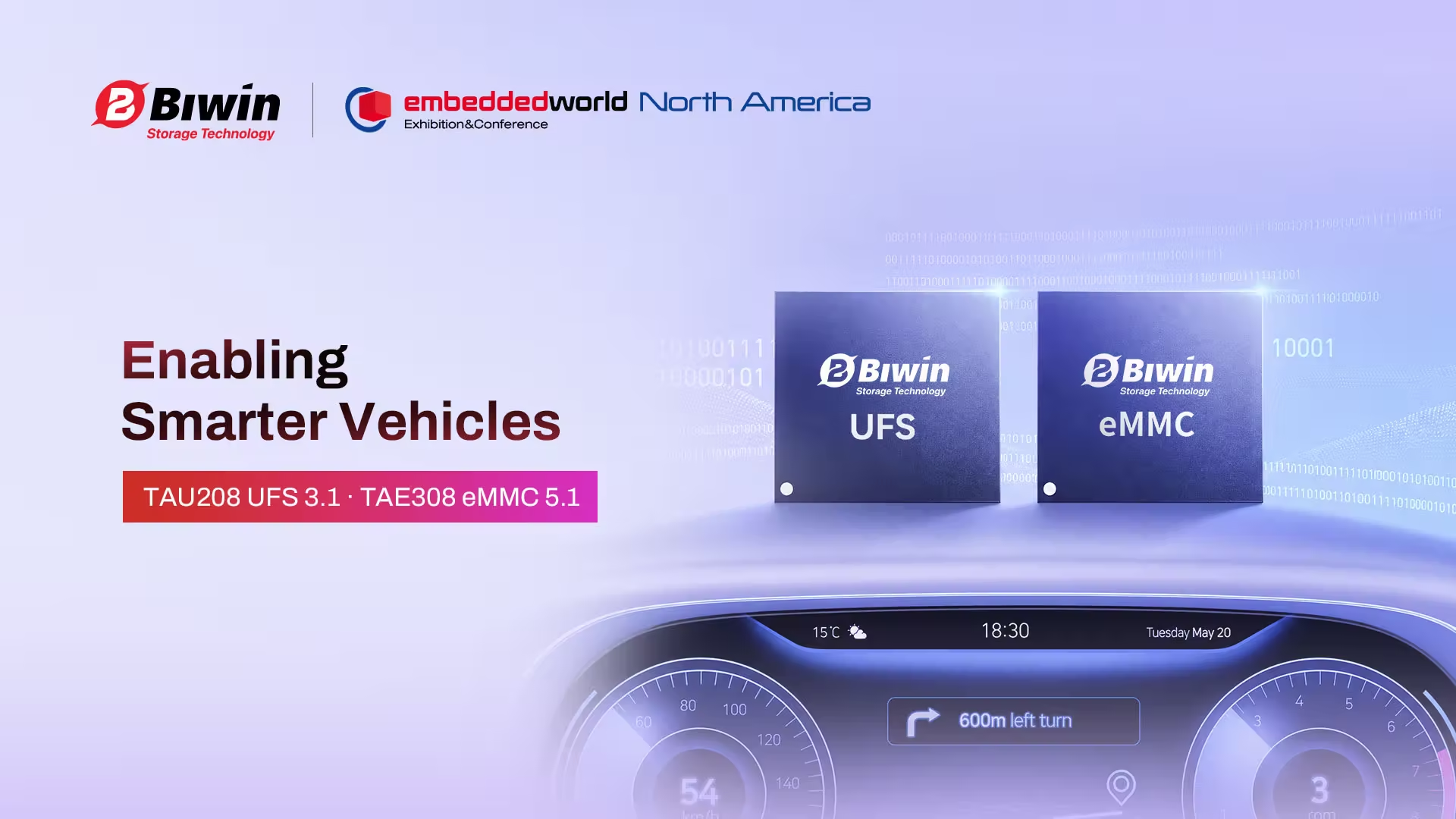
BIWIN’s automotive portfolio addresses these requirements with storage solutions for different levels of performance and system integration. The BIWIN TAU208 UFS 3.1 delivers sequential read speeds up to 2,150 MB/s for data-intensive applications and combines AEC-Q100 compliance with intelligent management capabilities including Deep Sleep, Performance Throttling Notification, and Error History logging. Its Deep Sleep mechanism can reduce sleep-mode power consumption by up to 95%, helping improve system-level energy efficiency.
Complementing it, the BIWIN TAE308 eMMC 5.1, built with BIWIN’s self-developed controller, provides compact embedded storage for intelligent cockpits, IVI systems, navigation, digital instrument clusters, T-BOX modules, and domain controllers. AEC-Q100 Grade 2 qualified and supporting operation from -40°C to 105°C, the TAE308 is designed for consistent performance and long-term reliability in demanding vehicle environments.
Together, the two solutions give automotive platform developers flexible storage options as vehicle architectures evolve toward greater intelligence, connectivity, and data intensity.
PC OEM Storage: Expanding Design Possibilities with Miniaturized High-Performance Storage
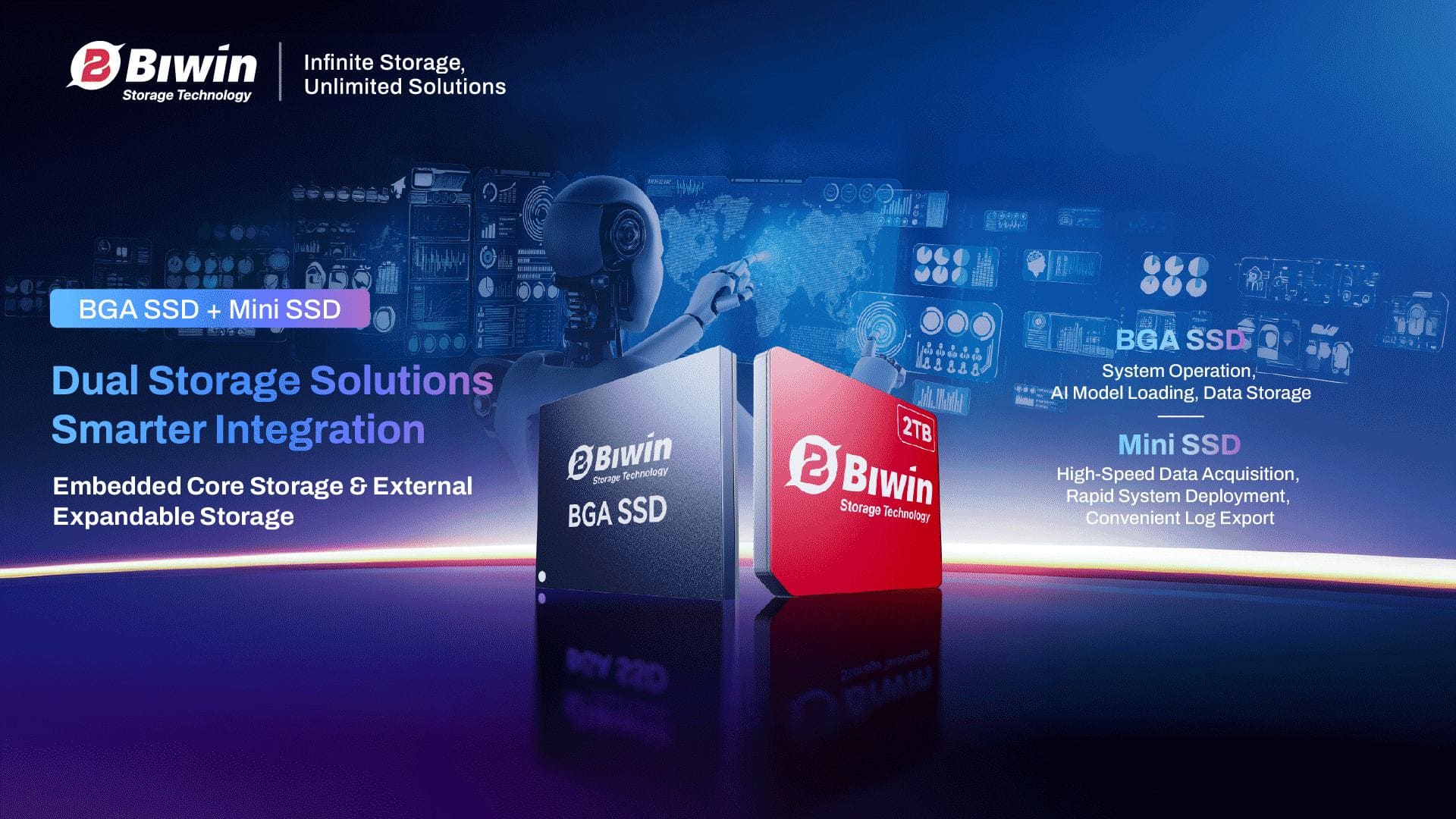
New generations of compact PCs, handheld devices, and edge systems are challenging the conventional trade-off between storage performance and physical footprint.
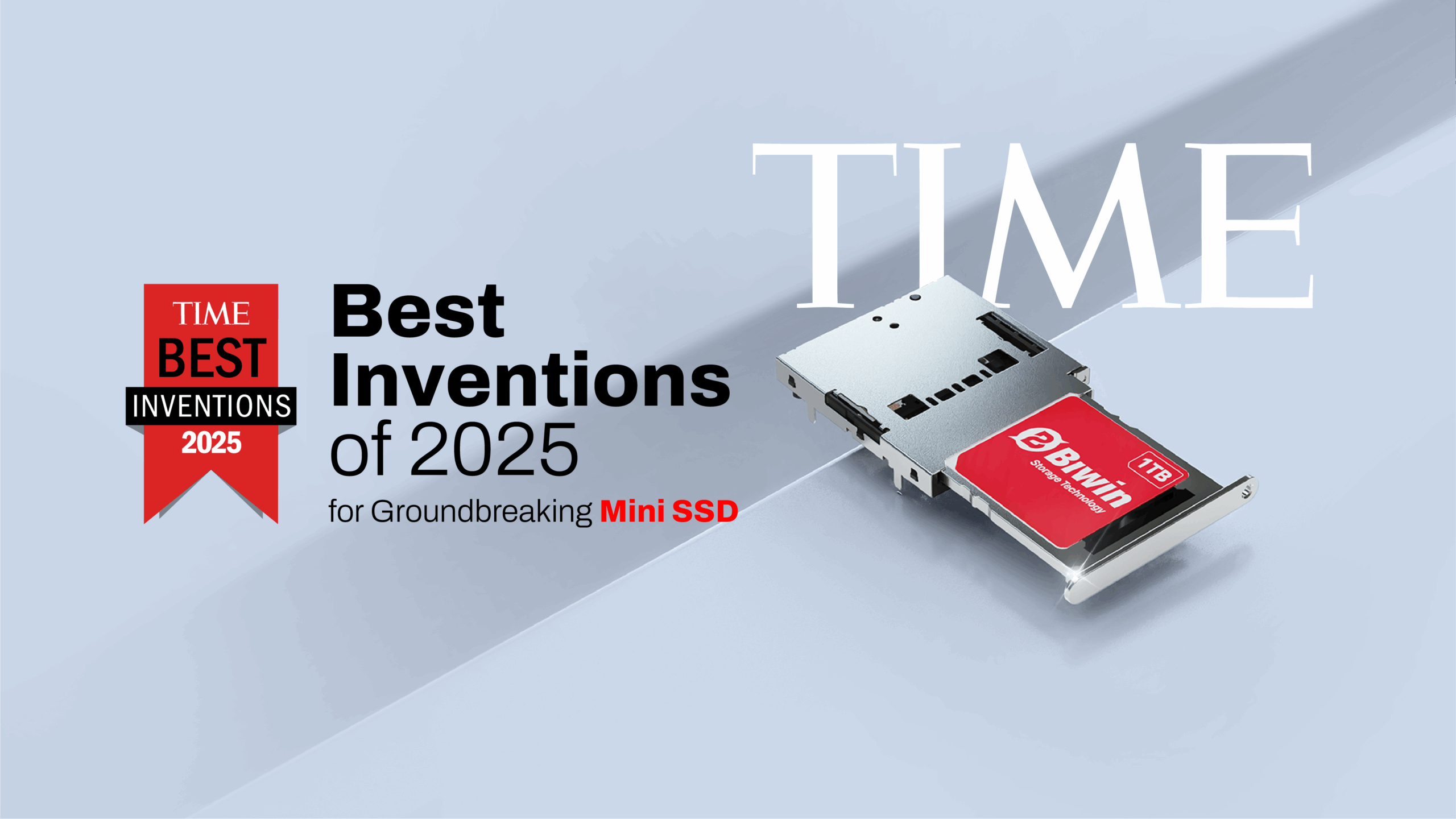
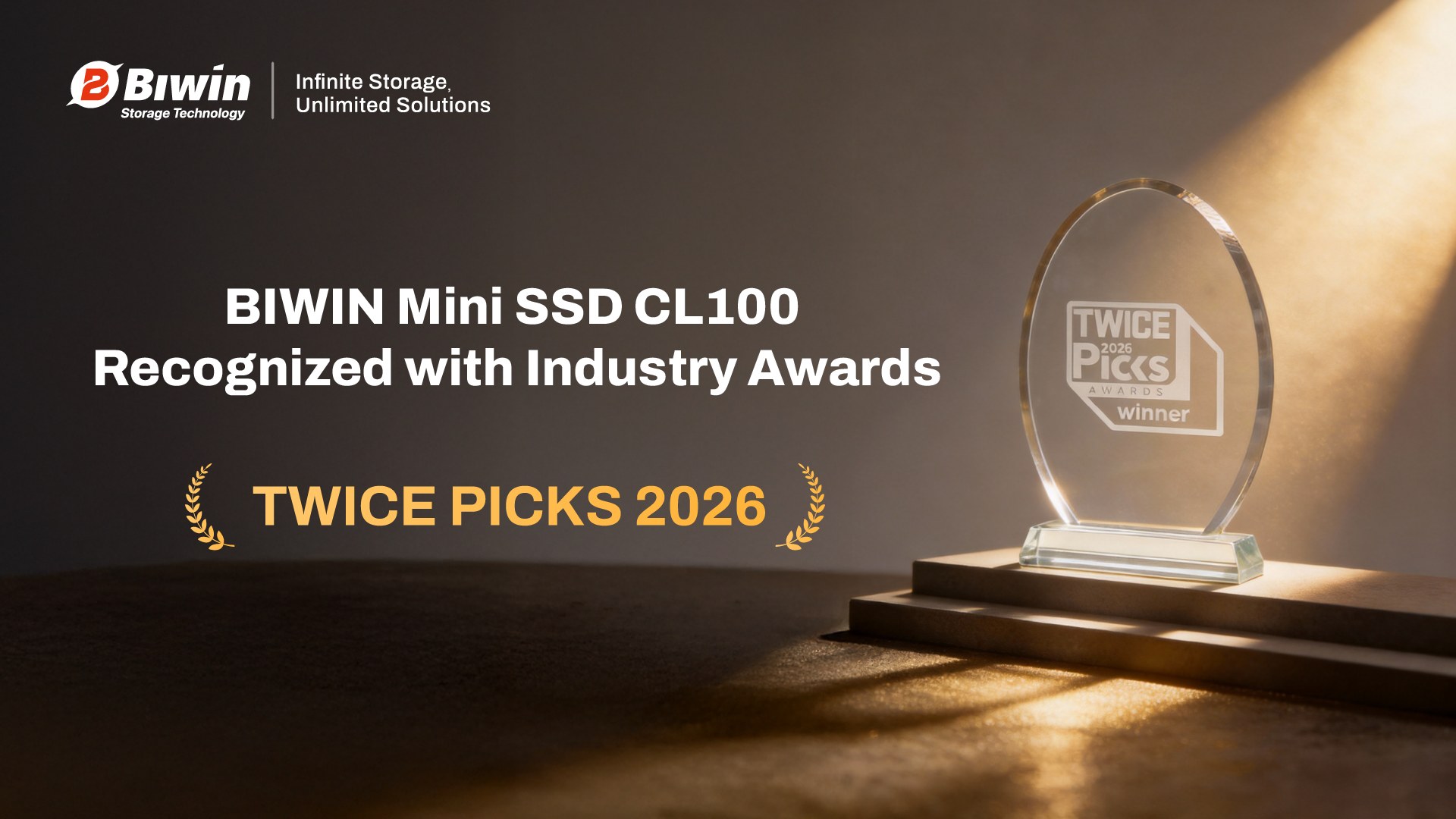
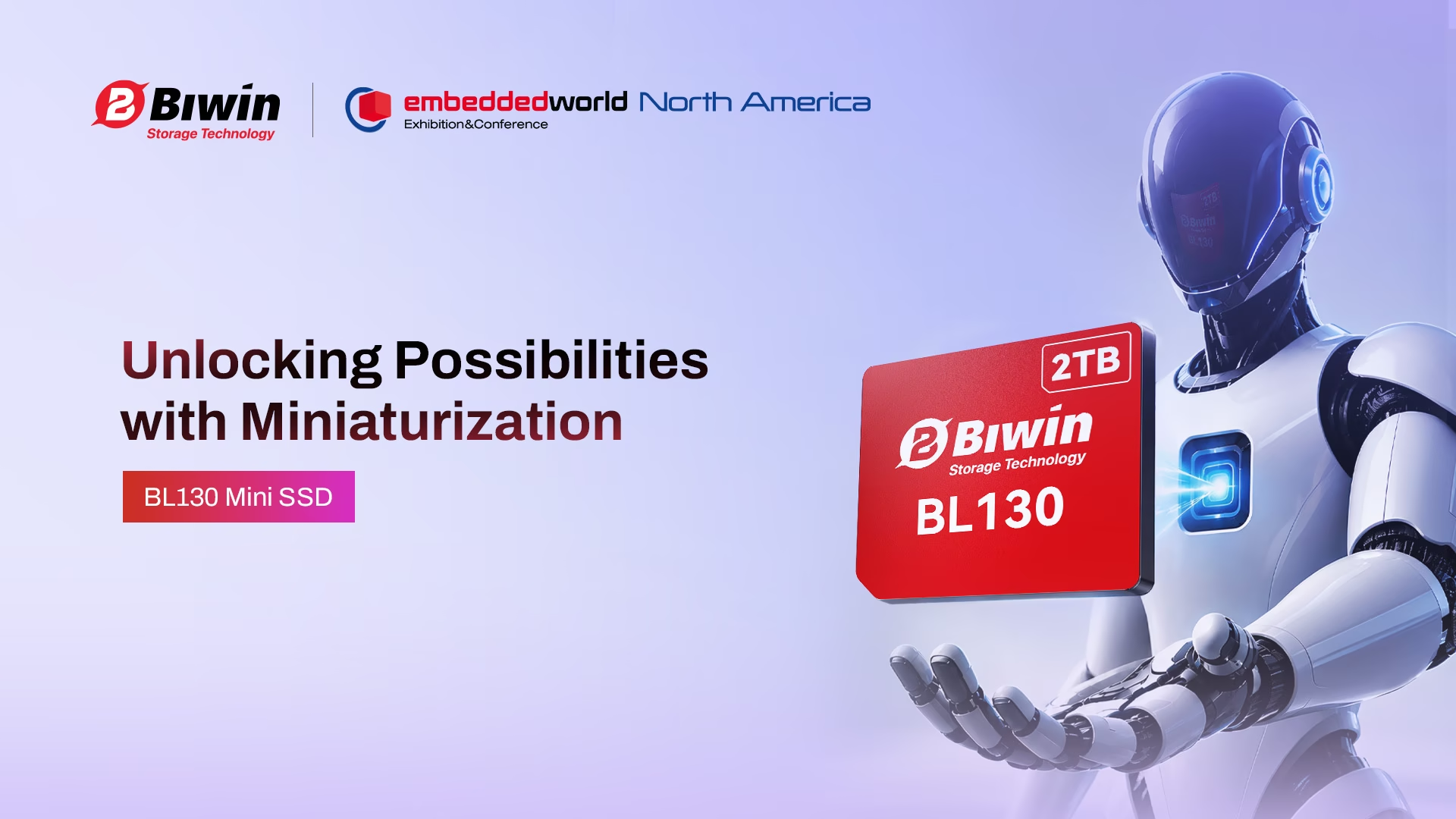
The award-winning BIWIN BL130 Mini SSD brings PCIe Gen4 performance to an ultra-compact form factor, delivering sequential read speeds up to 3,700 MB/s and capacities up to 2 TB. Its combination of small size, high performance, and meaningful capacity gives OEMs greater freedom to optimize internal layouts and develop thinner, lighter, or more highly integrated systems without sacrificing SSD-class storage performance. Designed for applications ranging from handheld gaming devices and compact PCs to edge AI platforms and smart cameras, the BL130 demonstrates how storage miniaturization can open new possibilities for next-generation device design.
Visit BIWIN at embedded world North America 2026
At embedded world North America 2026, BIWIN will demonstrate how its broad storage technology portfolio addresses the increasingly diverse requirements of modern computing, from AI infrastructure and always-on industrial edge systems to intelligent vehicles and highly integrated embedded devices.
Visitors are invited to meet the BIWIN team at Booth #6104 to explore the latest enterprise, embedded, industrial, automotive, and PC OEM storage solutions, discuss specific platform and application requirements, and learn how BIWIN’s capabilities across hardware, firmware, algorithms, packaging, testing, and manufacturing can support product development, customization, and long-term deployment.
- Booth: #6104
- Date: September 22-24, 2026
- Location: Anaheim Convention Center, Anaheim, California
For more information, please visit: www.biwintechnology.com
About BIWIN
BIWIN Storage Technology Co., Ltd. (SSE STAR Market, Stock Symbol: 688525) produces high-quality NAND Flash storage solutions and is recognized across enterprise, embedded, automotive, industrial, and consumer segments for its independent development capabilities in hardware, software, firmware, and storage algorithms.
BIWIN’s product portfolio encompasses PCIe NVMe SSDs, SATA SSDs, enterprise SSDs, DRAM modules, embedded storage solutions (ePoP/eMMC/UFS), automotive and industrial storage solutions, portable SSDs, memory cards, and USB flash drives.