Home > Products > SSD

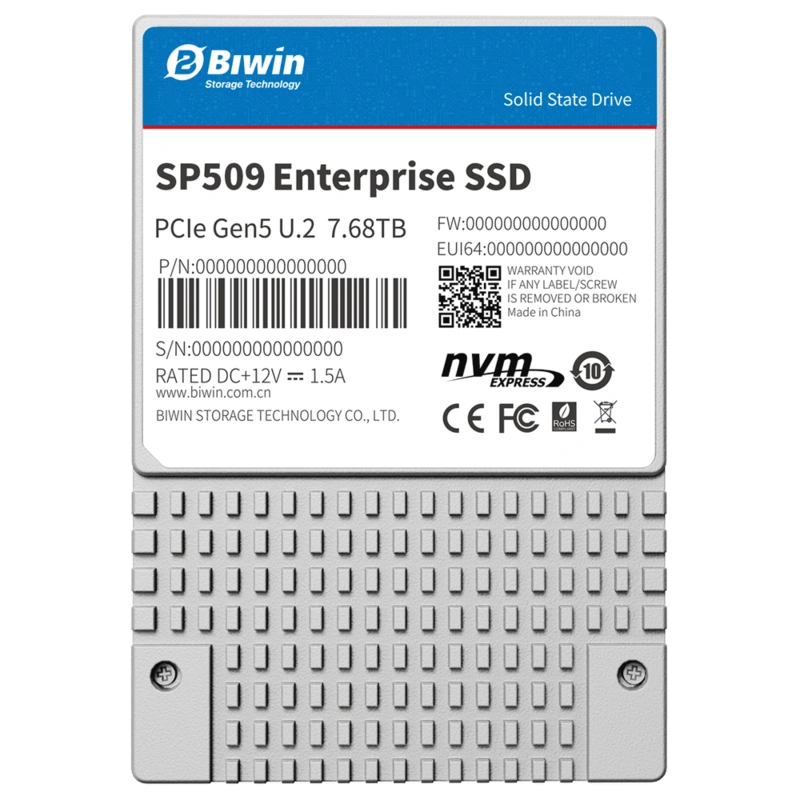
SP509 Enterprise PCIe SSD

High-performance PCIe 5.0 enterprise SSD built for AI, cloud-native, and HPC workloads

PCIe Gen 5x4, NVMe 2.0 & NVMe-MI 1.2
Up to 14,700 MB/s sequential read performance
Available capacities up to 15.36 TB
  • Capacity
    3.84 TB7.68 TB15.36 TB
  • Flash Type
    3D eTLC NAND
  • Operating Temperature
    0°C to +70°C

Overview

The BIWIN SP509 enterprise SSDs are purpose-built for AI model training and inference, cloud-native applications, and high-performance computing workloads in hyperscale and data center environments. Designed for high throughput, low power consumption, and enterprise-grade reliability, the BIWIN SP509 leverages a PCIe 5×4 interface with a standard U.2 form factor and complies with the NVMe 2.0 specification. It integrates end-to-end data protection, power-loss protection (PLP), and LDPC error correction to ensure data integrity under mission-critical conditions.

The SP509 can deliver up to 14.7 GB/s sequential read bandwidth and 13 GB/s sequential write bandwidth, too, along with up to 3,200K IOPS random read and 1,000K IOPS random write performance. Capacities include 3.84 TB, 7.68 TB, and 15.36 TB.

The SP509 also features a built-in hardware-based data compression and decompression engine that enables transparent data compression for host workloads. By reducing write amplification at the storage layer, it improves sustained performance and extends drive endurance while optimizing overall system efficiency. This design helps lower the total cost of ownership (TCO) in large-scale deployments without requiring changes to existing applications or workflows.

  • 01

    Compression Engine for Higher Performance, Longer Endurance

    A built-in hardware-based compression and decompression engine enables fully transparent data compression without any workload impact or application-level awareness. By significantly reducing NAND write amplification in AI storage and other data-intensive scenarios, the BIWIN SP509 delivers more than 2× performance improvement and extends drive endurance by over 5×. This translates into a substantially lower total cost of ownership (TCO) for enterprise deployments.
  • 02

    High Performance for Demanding Enterprise Workloads

    The SP509 unleashes the bandwidth potential of the PCIe 5.0 interface. Under a 2:1 compression ratio, it delivers up to 14.7 GB/s sequential read and 13 GB/s sequential write throughput, along with up to 3,200K IOPS random read and 1,000K IOPS random write performance. With low latency and strong QoS consistency, it effectively minimizes tail latency, ensuring stable and predictable performance under intensive and mixed workload conditions.
  • 03

    Enterprise-Grade Reliability and End-to-End Data Protection

    The SP509 integrates an enhanced LDPC error correction engine, delivering advanced error correction capability beyond standard NAND requirements to ensure strong data integrity and reliability. RAID functionality further enhances data protection and system-level fault tolerance, safeguarding data consistency in mission-critical environments. The SP509’s advanced wear leveling intelligently balances program/erase cycles across NAND flash to minimize uneven wear and extend drive endurance. Power-loss protection (PLP) ensures in-flight data is securely committed during unexpected power failures, preventing data loss or corruption in server-level outage scenarios. In addition, hardware-based encryption compliant with TCG standards provides robust data security, helping protect sensitive information and meet enterprise security requirements across data center deployments.
  • 04

    Higher Manageability for Lower O&M Cost

    The BIWIN SP509 supports in-band online firmware updates for non-disruptive upgrades, and enables out-of-band management via standard protocols to access drive health and telemetry data independently of host I/O. It also provides standard command interfaces for streamlined daily monitoring and maintenance, reducing operational complexity.
  • Transparent Compression Engine

  • NVMe 2.0

  • NVME-MI

  • OCP 2.0+

  • S.M.A.R.T.

  • Internal RAID

  • Atomic Write

  • Enhanced Read Retry Technology

  • Multi-dimensional Health Inspection

  • Power Loss Protection (PLP)

  • I/O QoS Control

  • AI Training & Inference

  • Cloud Computing

  • All-Flash Storage

  • High-Performance Computing (HPC)

Specifications

Latest Update: 2026/08/03
Product Line
SSD
Product Grade
Enterprise
Model Name
SP509
Interface
NVMe-MI 1.2, PCIe Gen 5×4, NVMe 2.0
Form Factor
2.5" U.2
Flash Type
3D eTLC
Capacity
3.84 TB
7.68 TB
15.36 TB
Sequential Read (Up to)
14,700 MB/s
Sequential Write (Up to)
13,000 MB/s (2:1 compression); 9,000 MB/s (1:1 compression)
4K Random Read (Up to)
3,200K IOPS
4K Random Write (Up to)
1,000K IOPS (2:1 compression); 400K IOPS (1:1 compression)
Random Read/Write Latency
55 μs / 7 μs
99.99% Read/Write Latency
15 μs / 100 μs
Operating Power Consumption (Max.)
25 W
Idle Power Consumption (Max.)
5 W
Operating Temperature
0°C to +70°C
Storage Temperature
-40°C to +85°C
UBER
≤ 1 sector per 1018 bits read
MTBF
>2,500,000 hours
DWPD
≥1 DWPD
Certifications
CE, FCC, RoHS, REACH, WEEE, HF, China RoHS
Warranty
5-Year Limited

Order Information

Capacity

3.84 TB
7.68 TB
15.36 TB

Part Number

CEAU2DBH110-3T8 / To be released in 2027 Q1
CEAU2DBH110-7T6 / To be released in 2027 Q1
CEAU2DBH110-15T3 / To be released in 2027 Q1

Power Loss Protection

Firmware-Based, Hardware-Based
1. Tested by BIWIN labs. Actual performance may vary due to systems, devices, or environment.
2. Maintenance and future updates are required throughout the product lifecycle. Specifications are subject to change without notice.
3. The pictures are for illustration only. Actual products may vary due to product enhancements or changes.
4. Not all products are sold in all regions of the world.
5. As used for storage capacity, one megabyte (MB)= one million bytes, one gigabyte (GB) = one billion bytes, and one terabyte (TB) = one trillion bytes. Total accessible capacity varies depending on the operating environment. As used for buffer or cache, one megabyte (MB) = 1,048,576 bytes. As used for transfer rate or interface, megabyte per second (MB/s) = one million bytes per second, and gigabyte per second (GB/s) = one billion bytes per second.
6. MTBF = Mean Time Between Failures based on internal testing using the Telcordia stress testing standard.
7. Please visit www.biwintechnology.com for warranty details in your region.
8. For more information, please contact sales@biwintech.com.

Documents

All Types

  • All Types
  • DRAM Module
  • Embedded
  • Memory Card
  • SSD
  • FMS 2026
Type
Title
Date
Operate
SSD BIWIN SP509 SSD Specification 2026-08-03 Download