Universal Flash Storage (UFS) and Solid State Drives (SSD) are two of the most popular storage solutions embedded in modern laptops, tablets, and handheld gaming systems. They’re both compact, high-performance solutions with expansive capacities, but they have very distinct form factors and speed profiles, making one better suited than the other in certain devices.
Different devices need different types of storage, but thanks to the development of modern standards like Universal Flash Storage (UFS) and Solid State Drives (SSD), there’s high-performance, high-capacity storage whether you opt for an embedded solution, or something swappable and upgradeable. BIWIN is consistently developing new and exciting storage solutions, and the latest BIWIN UFS 3.1 and SSD solutions offer robust options for device designers looking for high-performance, efficient storage solutions in every form factor.
BIWIN UFS 3.1
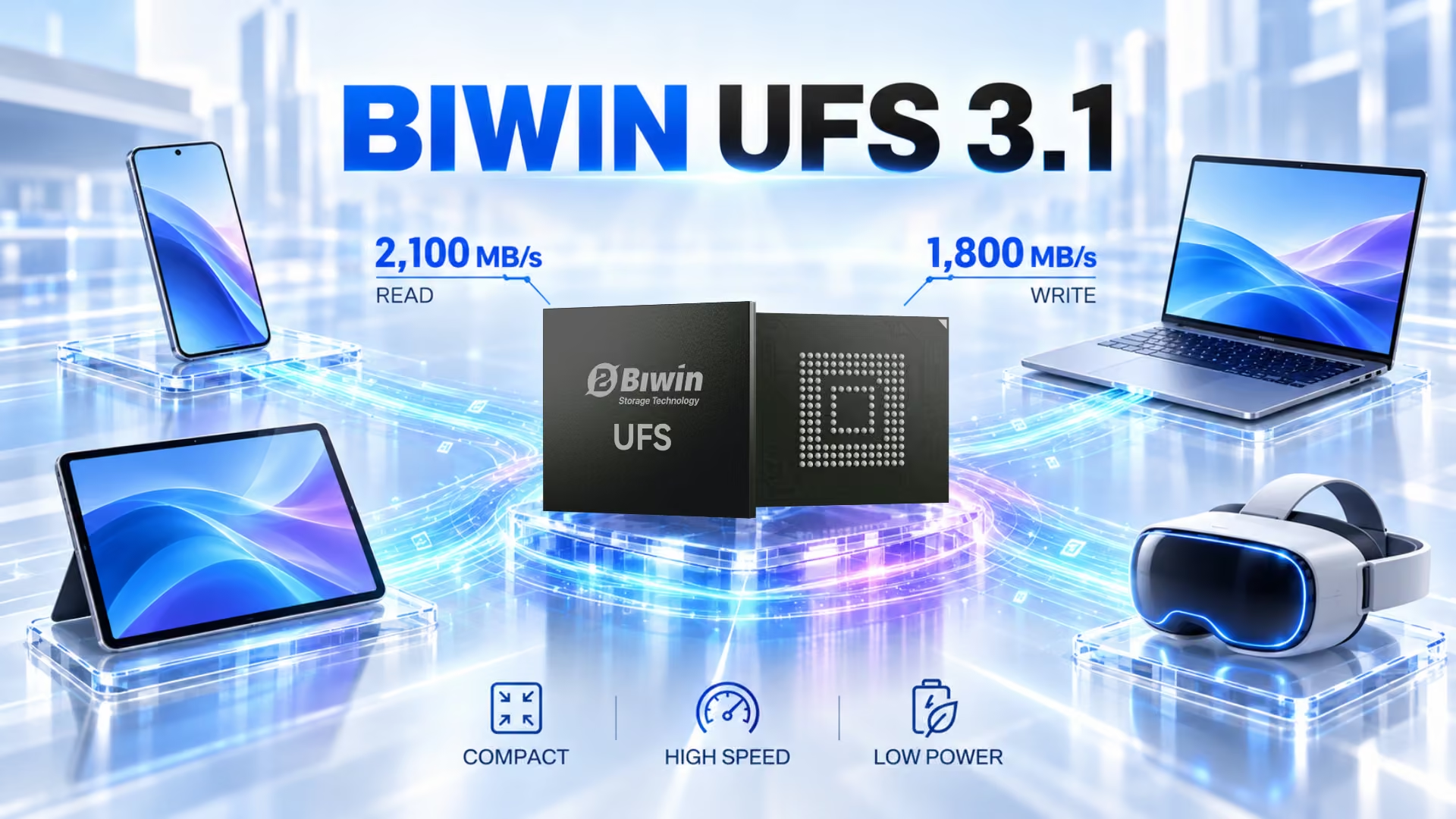
BIWIN UFS 3.1 is an embedded storage solution that is compact, fast, and uses very little power, making it the ideal solution for new smartphones, compact gaming devices, and some low-cost, lightweight laptops. It supports sustained read speeds up to 2,100 MB/s, and sustained write speeds up to 1,800 MB/s, and is available in capacities from 128 GB to 512 GB. Regardless of the capacity you opt for, it measures in at a miniscule 11.5 x 13mm, so it can fit into everything from lightweight wearables to larger gaming devices.
It can even operate within a wide operating temperature range of –25 °C up to +85 °C, so even in the most compact of high-performance devices, BIWIN UFS 3.1 can continue to offer strong performance. With its low-operating voltage, too, fitting your device with UFS 3.1 can be an excellent way to offer strong, high-capacity storage, while retaining lengthy battery life. If you want to learn more about the advantages of UFS, visit our article: Why Choose UFS?
BIWIN SSDs
For devices where greater performance and capacity are necessary, BIWIN embedded SSDs like the EP410 BGA SSD may be better suited. It has a larger profile, measuring 16 x 20 x 1.4mm, but it supports larger capacities, and both read and write performance is much greater than that of UFS solutions.
The BIWIN EP410 BGA SSD is available in capacities ranging from 256GB, up to 2TB in the same form-factor. It supports sustained read speeds up to 7,300 MB/s, and sustained write speed up to 6,300 MB/s, random read up to 1,000 IOPS, and random write up to 930K IOPS. Built around the PCIe Gen4x4 NVMe 2.0 interface, this embedded SSD offers premium performance for faster data access, cutting down on load times and improving device responsiveness.
For larger devices which can take advantage of non-embedded storage solutions, BIWIN offers M.2 industrial SSDs, like the TGQ203 in the 2280 form factor, as well as 2230 form factor drives, like the TGQ205. They’re built using the same high-grade, industrial TLC NAND Flash memory, and can operate in demanding environments with a wide operational temperature range.
BIWIN also supports mass enterprise PCIe SSD storage solutions in the form of the SP5002, which has a capacity up to 61.44 TB on a single drive, with the PCIe 5.0 interface delivering sustained read speeds up to 14,700 MB/s. Ideally suited for sustained, high-demand workloads and trash collection, it delivers exceptionally consiste