Description: It’s not often that new technologies change an entire approach of global industries, but the development of Non-Volatile Memory Express changed the world’s approach to data. With the ability to read and write data across thousands of queues simultaneously, NVMe SSDs weren’t just faster than SATA SSDs and hard drives, they made possible the modern computing world we now.

The development of NVMe technology fundamentally changed storage forever. It revolutionized the performance potential so much, that it changed the way storage interacted with compute infrastructure, and made the modern computing industry possible. It took storage from a component that was all about capacity and bandwidth, and made the importance of latency abundantly clear, by making it much, much faster than anything that came before.
Before NVMe, SATA was its own game changer. Sustained read and write speeds more than doubled over typical hard drive speeds – even 10,000 RPM SCSI drives couldn’t keep up. Random access times were many orders of magnitude faster, too, making consumer PCs feel snappy and responsive without sluggish hard drive response times, and enterprise could suddenly move masses of data without the long-transfer times of hard drives.
Then NVMe technology took it one step further; Not just improving read and write speeds dramatically,but rewiring the storage infrastructure to create a whole new paradigm. NVMe gave SSDs a direct, low-latency path to the CPU over the PCIExpress interface, rather than through the traditional SATA pipeline–and that opened a whole host of potential.
Building beyond SATA
As useful and capable as SATA was (and still is) as storage technology, SATA was introduced in the early 2000s to build upon existing Parallel ATA (PATA) technology. Its designers built it around the then-premier storage medium: Hard drives. As SATA SSDs matured, they pushed the interface to its limits, maxing out at 550 MBps of sustained read and write performance. More importantly, though, SATA SSDs could only use a single storage request queue, which was itself limited to just 32 commands.
Introduced in 2011 to address these bottlenecks, a NVMe technology did so in dramatic fashion. As well as uncapping read and write performance by tying it to the bandwidth of the PCIexpress interface – the per-lane bandwidth of which has effectively doubled with each successive generation – it also massively expanded the storage request queue. Where a SATA SSD could only use a single queue thanks to the Advanced Host Controller Interface, NVMe SSDs had no such limitations. They can leverage over 64,000 storage command queues, each of which can manage over 64,000 commands per queue.
From a consumer storage perspective, this unlocked higher sustained read and write performance, faster random access times, and overall faster loading games, applications, and operating systems. But for enterprise, the effect was far greater.
Suddenly, databases could work with much greater datasets spread across a greater array of drives, modern data center design became possible with more distributed server layouts, and high-performance super-computing became viable. NVMe helped remove storage as a bottleneck for data intensive, deep-learning, and analytical workloads.
The foundation of modern computing
NVMe technology was never just the next-generation of storage technology, it’s what ultimately became the foundation of modern high-performance storage, underpinning various industries that wouldn’t be possible without it. NVMe technology doesn’t just make individual drives faster, it lets storage scale with the compute platform. As PCIexpress bandwidth increases, NVMe SSDs can keep pace and allow modern processors and accelerators to access the data they need to function, without the protocol overheads of legacy interfaces.
For device makers, system builders, and data center designers, that translates into faster responsiveness and more versatile deployments. With such a low latency and high-bandwidth storage interface in place, NVMe’s development marked the moment SSDs stopped working like faster hard drives, and became central to the architecture of modern computing itself; One that continues to shape modern PCs, servers, and AI infrastructure today. Want to learn more about how SSD technology supports AI acceleration? Read more here.
NVMe in smaller form factors

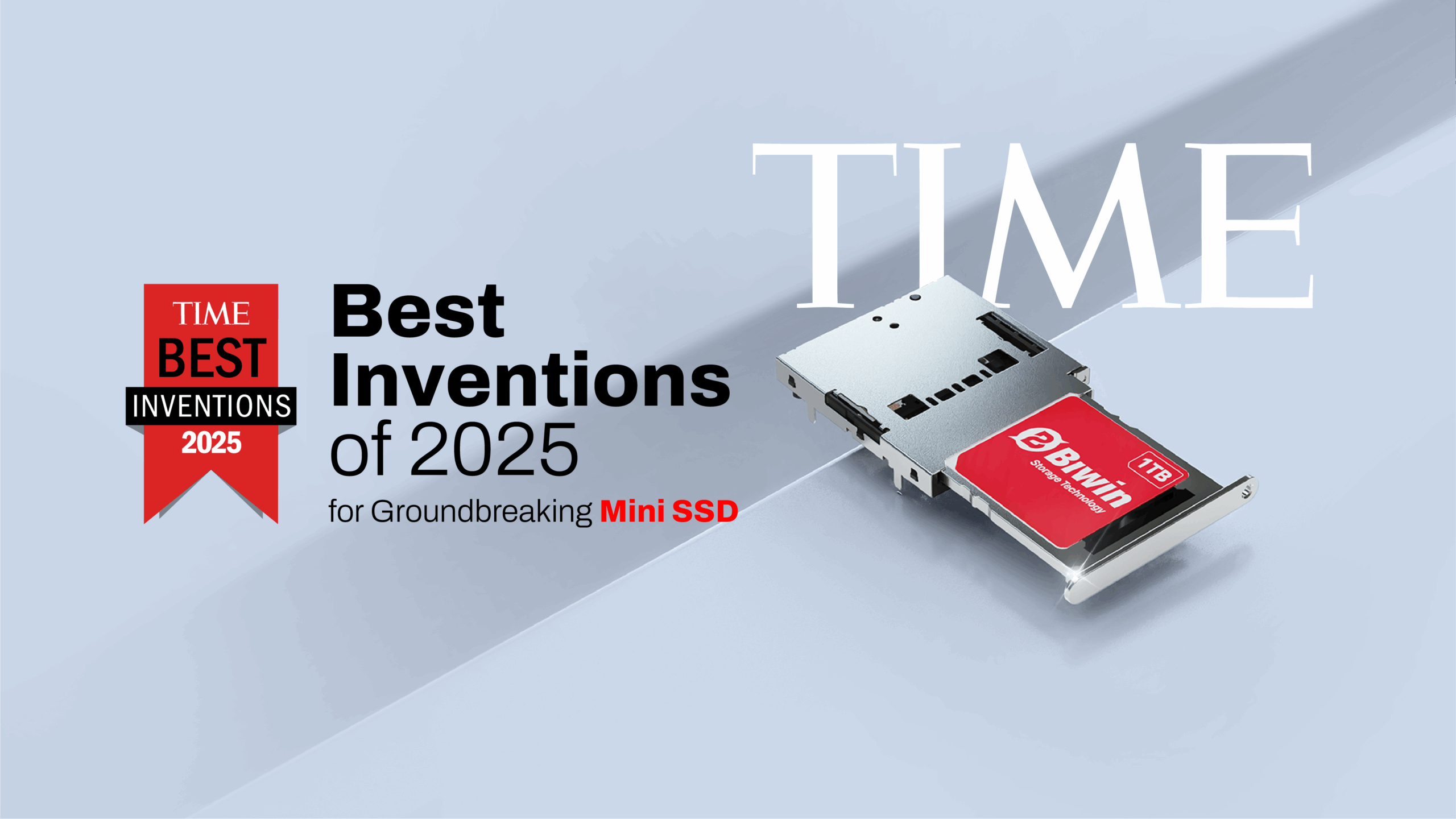
NVMe’s evolution hasn’t stopped at increasing bandwidth, either. As devices have become smaller and more specialized, storage has had to shrink with them, without giving up the performance advantages that made NVMe so important in the first place. The BIWIN BL100 Mini SSD is one example of that shift, fitting PCIe 4.0 x2 and NVMe 1.4 storage into a 15.00 × 17.00 × 1.40 mm form factor, with capacities ranging from 512 GB to 2 TB.
The BL100 can deliver sequential read speeds up to 3,700 MB/s and write speeds up to 3,400 MB/s, while its removable design gives compact systems an alternative to permanently soldered storage. That makes the Mini SSD format particularly relevant to handheld gaming systems, Mini PCs, ultrabooks, and other devices where internal space is limited, but fast, accessible storage is still important.
The BL100 is ultimately just one example of how far that original shift in storage architecture has carried. NVMe started by removing the limitations that held SSDs back, but its longer-lasting impact has been giving storage the flexibility to evolve alongside computing itself, from the largest data centers, right down to some of its smallest devices.